
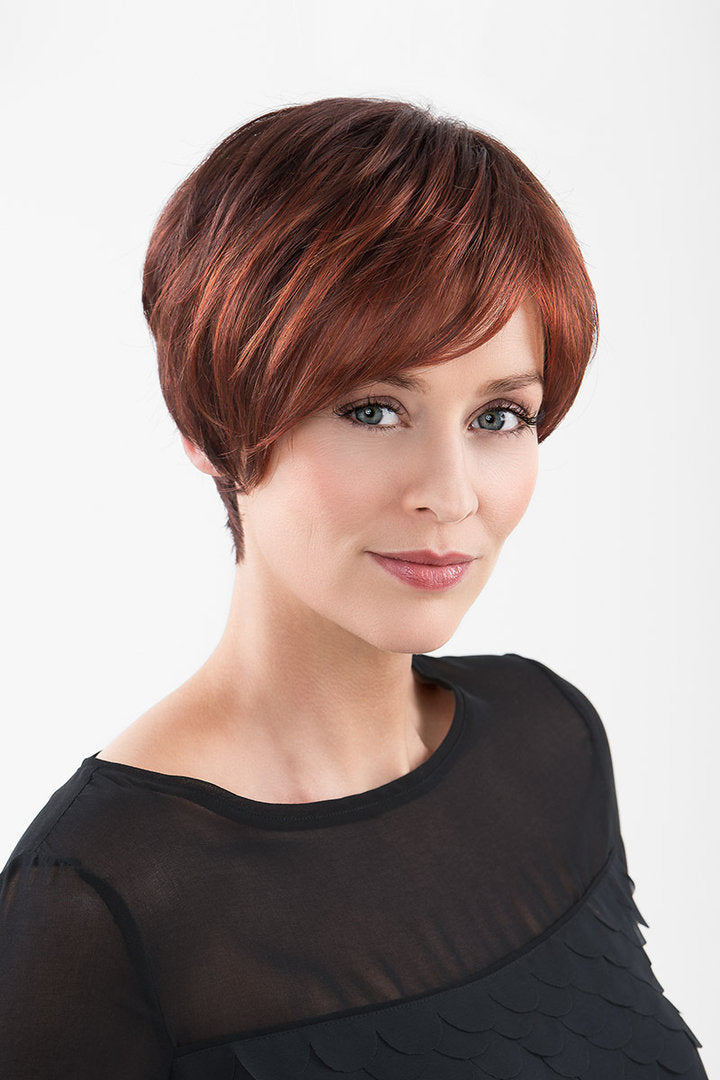




At a Glance
A wig fits correctly when it is secure, comfortable to wear, and looks natural. It should neither pinch nor slip nor cause feelings of tension. Crucial for an optimal fit are not only the head circumference but also the correct wig size, the construction of the cap, and professional adjustment.
Especially in cases of medically related hair loss, for example due to chemotherapy or alopecia, the fit plays a decisive role. A well-fitting wig provides security in everyday life, increases comfort, and helps one to feel comfortable again.
In this guide, you will learn:
- how to measure your head circumference correctly,
- which wig size fits you,
- how to recognize whether a wig is too big or too small,
- the differences between Petite, Average, and Large,
- which cap construction is suitable for your needs,
- what people undergoing chemotherapy or with alopecia should pay particular attention to.
Why the right fit is so important
When buying a wig, many people initially focus on hairstyle, hair color, or hair quality. This is understandable—after all, the new hairstyle should look natural and match your own style. However, in our daily consultations, we experience that the fit is at least as important as the appearance. A high-quality human hair or synthetic hair wig can only fully unfold its benefits if it fits optimally.
A well-fitted wig
- distributes its weight evenly on the head,
- remains securely in place even during everyday movements,
- ensures a pleasant wearing sensation over many hours,
- avoids pressure points and friction,
- looks particularly natural at the hairline.
If the fit is not optimal, however, discomfort can occur after only a short time. A wig that is too tight can cause pressure points or contribute to headaches. A wig that is too large slips more easily and often conveys an insecure feeling when worn.
Expert tip from Thomas Herrmann
"In over 30 years of consulting, it has become clear time and again: The most beautiful wig is of little use if it does not fit correctly. The right size and professional adjustment are decisive factors in how comfortable our customers feel with their wig."
What does the fit of a wig depend on?
Many believe the right size is the only decisive factor. In fact, a good fit is composed of several components.
1. Head circumference
The head circumference forms the basis for selecting the appropriate wig size. Even a difference of a few centimeters can decide whether a wig sits comfortably or slips permanently.
2. Head shape
Even people with identical head circumferences can have different head shapes. For example: a rounder head, an elongated back of the head, a flat back of the head, or a higher or lower hairline. These differences often influence the fit of the wig more than many suspect.
3. The cap construction
The so-called cap (monture) forms the basic structure of every wig. Depending on the workmanship—for example, wefted, monofilament, or lace front—elasticity, adaptability, ventilation, comfort, and natural appearance differ. Therefore, two wigs of the same size can fit completely differently.
4. Existing natural hair
Existing natural hair also influences the fit. During chemotherapy, the situation often changes several times: initially, your own hair is still present, then it gradually falls out, and later, new hair grows back. As a result, the required fit can also change over time.
How to measure your head circumference correctly
Choosing the right wig size always begins with an accurate measurement of the head circumference. You only need:
- a flexible measuring tape
- a mirror
- possibly a second person for assistance
Step 1
Place the measuring tape in the center of the forehead about one centimeter above the hairline.
Step 2
Guide the measuring tape along the sides over the ears.
Step 3
Run the measuring tape over the fullest point of the back of the head.
Step 4
Close the circle again at the forehead. Ensure that the measuring tape lies snugly without cutting in.
Practical tip: Repeat the measurement two to three times. Small measurement errors of one centimeter can already influence the choice of size.
Which wig size fits which head circumference?
Most manufacturers use three standard sizes.
| Wig size | Head circumference |
|---|---|
| Petite / Small | approx. 51–53 cm |
| Average / Medium | approx. 54–56 cm |
| Large | approx. 57–61 cm |
These values serve as a guide. Sizes can vary slightly depending on the manufacturer. At La Peruca, we therefore do not advise you solely based on head circumference. Head shape, cap construction, and individual wishes are also incorporated into the selection.
Petite, Average, or Large – what do the sizes mean?
Petite / Small
Petite wigs were developed specifically for people with a smaller head circumference. Typical head circumference: 51 to 53 cm. They sit tighter on the head and prevent excess material at the nape or temples. Petite sizes are particularly suitable for:
- petite people,
- teenagers,
- many women with a narrow head,
- people with complete hair loss.
Average (standard size)
Most wigs are produced in the standard size Average. Suitable for a head circumference of about 54 to 56 cm. Through integrated adjustment straps, this size can often still be easily adjusted.
Large
For people with a larger head circumference, many manufacturers offer special Large models. Typical head circumference: 57 to 61 cm. These wigs prevent uncomfortable pressure and ensure that the cap lies evenly. Especially larger heads often benefit from specially developed Large caps, as standard sizes here often create constant tension.
Is the head circumference alone enough?
Not always. During our consultation, we additionally measure other head dimensions if necessary.
| Measurement | Meaning |
|---|---|
| Forehead to nape | Length of the head |
| Ear to ear | Width of the crown |
| Temple to temple | Position of the hairline |
| Back of the head | individual head shape |
These additional measurements are particularly helpful when:
- custom-made production is planned,
- special sizes are required,
- the back of the head is particularly flat or pronounced,
- other wigs have already fit poorly.
Exactly for this reason, two people with an identical head circumference can still require different wig sizes or cap constructions.